Friday, February 25, 2011

Chapter Thirty thru Thirty-two

CHAPTER THIRTY

Rome, Italy
Same Hour Local

Andre D’Tiene twisted the cork from a bottle of wine and poured the dark red liquid into a deep glass. Swirling it a few times to release the wine’s aroma, the President of the Mediterranean Union brought the glass to his lips and took just a sip. The day had been long and arduous, but this moment was one to savor.
D’Tiene could not help but be satisfied. All of his posturing, all the maneuvering he’d done was now bringing his dream to fruition. The pawns on the board had been positioned according to his design and were now moving in a manner determined by his orchestrations. The beautiful aspect came from seeing how each player thought they had the upper hand. None had seen that he was the master in everything that was happening.
Reginald Tipry, personal assistant to the president, quietly stuck his head in the door and smiled. “Israel is preparing to commit its arsenal. It is only a matter of time,” he said.
“What is the current status?”
“Air battles are taking place over the entire region, just as you desired,” the aide’s smile widened.
“They have attacked the Saudis?”
“Actually, the Saudis attacked Israeli warplanes over Jordan. The Jews are now responding.”
“Splendid! That is far better,” D’Tiene nodded his head. After taking another sip of wine, the president looked directly at his aide. “Have the Russians begun to move?”
“That is the strange thing about what is happening,” said Reginald. “They have not budged, nor have they increased their alert status. They seem to be letting it all play out.”
“Tell me the moment the Russians show any sign of advance.”
“Yes, Mr. President,” Reginald answered as he shut the door.
D’Tiene’s brow wrinkled. Why would the Russians be sitting back? Why wouldn’t they be moving in for an easy kill? Surely they understood the Israelis could not engage their divisions with nuclear weapons. The Russians were much too close to the Lebanese border for that, plus the prevailing winds were sweeping toward Israel from the north. The Jews would never do anything that would assure their peoples death by radiation fallout over their territory. The set up was perfect for the Russians to sweep down and subdue the Jews before things got out of hand. Yet, there they sat, unmoving and seemingly unconcerned. It did not make sense.
D’Tiene sat down in the soft leather of his sofa and stared out the window over Rome’s historic district. But he wasn’t comforted by the sight. Something was going terribly wrong with his plan and he didn’t understand why.

Saudi Arabia
Wednesday, 11:40 p.m.

Moshe’s canopy was awash with light from the many explosions taking place on the base. However, it was a streak of burning fuel several miles to the east drew his attention. It was followed by an expanding fireball at what appeared to be above ten thousand feet. That had to be an S-300, and a momentary panic washed through Moshe’s system.
“Frisbee—Dagger—give me your status,” Moshe called to his wingman. There was no response. “Frisbee—do you copy?”
Rueben finally responded, but he sounded as if he were nearly out of breath. His transmission was cluttered with static. “Dagger, I’ve been hit.”
“Hang on, I’m heading your way,” Moshe said as he pulled the nose of his F-16 in the direction of his wingman.
“No, I’m not going down, but I am out of the fight.”
“Head for Ramon,” Moshe ordered. He then regained his attack profile on the nearest launch platform.
“Roger—Captain, I’ll see you back at the base.”
“Stay low out of the zone then grab some altitude once you cleared the range of these 300s,” Moshe ordered.
“I will,” Rueben responded. After a several seconds of silence, Rueben’s voice again came over the radio. “And Moshe, I want you to know I did what you said. I felt it.”
Moshe’s breath caught in his throat. After their long conversation at the base, Rueben had hardly responded to the layout of the truth he’d been shown. Moshe had decided to forge ahead, even sharing how a person could meet Messiah personally. Nothing had registered on his wingman’s face. He’d barely acknowledged that he’d heard. Now Moshe realized the kid had actually been listening, so much so that he’d prayed the prayer at some point during the mission.
“That’s good kid,” Moshe transmitted. “I’m proud of you. Now be careful and get home.”
All Moshe heard in return was the crackle of Rueben’s damaged radio.
“Thank you, Y’shua,” he whispered.
Just then, Moshe’s threat receiver chirped with more intensity. The S-300 radar unit, now eight miles directly in front of him, was attempting to pick him out of the ground clutter. In the same instant, his Maverick growled its readiness for launch. His thumb moved up the stick and pushed the button. The weapon surged forward into the dark sky.
Moshe increased his speed and worked his way into depression. He was now over flat desert again and heading almost directly west. Although one S-300 launch platform remained, without his wingman he was outgunned. Not only that, but the odds were at least two, possible three missiles were in the air trying to acquire the heat signature of his engine. The time had come to bug out.
“Jackhammer—Dagger is exiting the sector,” he transmitted to the F-15 leader that was attacking King Khalid at that very moment. “You’ll have no opposition from the air. Hafar-al-Batin is inactive.”
“Roger—Dagger—Be advised, we’re down two planes,” came the response.
Moshe’s heart sank felt like it sank in his chest. Two F-15s had been destroyed by S-300 missiles.
“Get as many as you can and then clear the area,” Moshe ordered.
“Another three minutes and we’ll be on your tail.”
Moshe stayed low to the earth as he angled his fighter a bit more toward the Iraqi border, now less than fifty miles to the north. He exhaled slowly as his instruments confirmed he had escaped without become a target for the Saudi missiles. Instinctively, he pulled back on the throttle to lower his airspeed and conserve fuel. He would have to traverse Jordanian airspace, and the possibility existed that he would encounter enemy aircraft.
Just then Rueben’s voice crackled again in his earpiece. “Dagger, I’ve got two American F-18s closing in on my six. They’ve locked onto my tail and my threat alarm is screaming.”
“Engage your IFF!”
“Negative—Dagger—the transmitter is damaged. It’s not functioning,” Rueben responded. “Oh no, they’re firing! The Hornets are firing. I’m blowing chaff now.”
Moshe punched in the guard frequency he knew the American Air Force utilized and spoke as clearly as his racing heart allowed. “American flight of two F-18s, you are firing on an Israeli aircraft. Repeat, break off your attack! You have fired on friendly aircraft.” There was no response. “American F-18 pilots, you are attacking a damaged F-16 of the Israeli Air Force. Disable those Sidewinders.”
Moshe saw that Rueben was now less than forty miles ahead and desperately attempting to evade the two American Sidewinder missiles converging on his tail. The F-18s were showing on the HUD as a faint echo, almost as if they were simply dim feedback from ground clutter. He glanced forward out his canopy until he saw Rueben’s burning chaff falling to the earth. He then traced a line back in the sky until he saw two steady lights moving in the same direction as his wingman. Those blips were the power plants of F-18 engines, and they would be easily acquirable for the infrared radars of his AMRAAM missiles. With a punch of a button Moshe tasked two missiles on the Americans and fired.
“Flight of two American F-18s, you are now under attack by Dagger Flight of the IAF. Break off and punch the self-destruct on those Sidewinders.”
All he heard was a deep throated laugh over the radio. “So you kids want to play with the big boys, eh? You fellas just attacked an ally of the United States of America. Prepare to eat some sand!”
Anger gripped Moshe. He watched the Sidewinders gain quickly on the blip that identified his wingman. The Americans had less than fifteen seconds to issue the self-destruct command or his partner would be killed, but they were challenging him to fight. He could hardly believe what was happening.
“Punch out, Rueben, punch out!” Moshe shouted.
A distant flash told Moshe his friend, and new brother in Messiah was gone. Rage surged from somewhere deep in his soul, prompting him to jam the throttle forward and to apply the afterburner to his engine. He had a new enemy.
“Dagger—Dog Pound—You are ordered to stand down and return to base,” sounded the voice of the flight controller, somewhere over the skies of Israel. “I repeat…stand down! The Hornets are off limits.”
Moshe hesitated.
Again, the voice of the controller penetrated his cloud of wrath. “Look Dagger, we all saw what just happened, but our orders are clear. Stand down!
Moshe had no choice. He backed off the afterburner and returned to his original heading. Several minutes passed before he could will himself to disengage his attack radar.

CHAPTER THIRTY-ONE

Jerusalem
Thursday, November 19
12:00 a.m.

Prime Minister Naftali took a sip from a mug of hot tea. He was hoping the liquid would ease the crushing weight he felt in his soul. Whether it was from guilt, or from the burden of defending his people, he knew not.
The door to Naftali’s private chamber opened and in stepped General Katz.
“What word, Ehud?” asked the Prime Minister.
“Phase one is nearly complete. We are awaiting the return of our squadrons from Arabia and Egypt before we proceed.”
“What are our losses?” Naftali knew there would be casualties, but he was well aware that this night’s activities would usher in a far deadlier confrontation with the so-called coalition forces. Israel would need every pilot, every fighter jet, and as much of its brigade forces to repel what was sure to come.
“Surprisingly few,” Katz answered as he poured himself a cup of tea and sat down. “We’ve lost no aircraft to Egyptian anti-aircraft fire, although one F-15 was lost due to a mechanical malfunction. Those pilots were retrieved. Saudi Arabia is a different story.”
“How so?”
“We suspected the Russian S-300 system was formidable, and it was. Even so, we faired quite well in our first encounter. Seven protected bases were attacked and, from the after-action-report, we eliminated ninety percent of the Saudi’s launch platforms.”
“But?” Naftali could detect the stall in sharing the complete picture.
“But, we lost seventeen aircraft; nine F-15 Ra’ams and eight F-16 Baraks. Considering we utilized forty-seven fighters to accomplish the mission, our losses were much higher than we’d hoped.”
Naftali stiffened at the numbers. “Ehud, those are losses of thirty-six percent. That is unsustainable.”
“I agree, Yosef, but we are not being forced to sustain them. The mission was accomplished.”
“How many pilots does that add up to?”
“Twenty-six,” whispered Katz, “and all seasoned veterans.”
“And what rescue operations are under way to recover them?”
“None.”
Naftali’s eyes locked onto his general’s as he sought to grasp what his friend was saying.
Katz saw the cloud that draped itself over the prime minister’s face. “We cannot launch search-and-rescue. If any of our brave men and women survived the downing of their planes, we will soon be assuring their death by what we are about to unleash.”
“Dear Jehovah in heaven,” Naftali mouthed then lowered his head into the palms of his hand.
Katz understood his friend’s reaction. The man had lost his parents in the fires of Auschwitz, as had many of those in the administration. They, of all the citizens of Israel, understood the extreme measures that had to be taken in order to insure the survival of the Jewish people. If that meant inflicting a holocaust to prevent a holocaust, so be it.
“Yosef,” Katz spoke softly, “it is time to process the launch. You must give the order personally.”
Naftali made no move for several long minutes. It was as if he had fallen asleep, but Katz knew he hadn’t. Though the decision for initiating Operation Clean Slate had been made hours ago, this final phase of nuclear response was the true challenge to any man’s moral compass. Naftali had proven long ago that he had the courage and fortitude to do what was necessary. Still, issuing the decree to annihilate a large portion of the Arab populations that surrounded Israel carried a weight that was overwhelming.
Finally, the prime minister lifted his head, drained the last swallow of tea from his mug, and followed the general to the communications room.

Northern Israel
Thursday, 12:10 a.m.

From twenty thousand feet one could view the entire State of Israel. The sight made Moshe’s heart ache. Even though he was high over the Negev and heading toward the sea, hundreds of fires were visible. He was stunned by the numerous rocket trails encroaching into his country. Though a mandatory blackout was in effect in every city, explosions and burning buildings provided enough light for a pilot to visually track his way from city to city.
The northern and eastern horizons were even more chaotic. Little discernment was needed to know that Jordan and Lebanon were experiencing the horror of thermobaric weapons. Moshe was sickened. Civilians were dying on both sides. Worse, people were dying without the knowledge of the truth. Souls were being lost for all eternity. Maybe other defenders of Israel felt satisfaction in destroying the enemy. All he could feel was an overwhelming sense of loss.
Something deeper than his natural human emotion had grabbed hold of his gut. In that moment, Moshe understood that God was grieved. Mankind was his passion, even though man’s evil demanded judgment. God did not arbitrarily issue judgments. His acts of discipline were meant to bring repentance and restoration. This was true for Jews and Gentiles alike. It mattered not whether one was of the line of Isaac or Ishmael. Every life was valued. But life was consumed by sin, and unless repentance turned a person’s heart to God, the condemnation to die had already been issued.
A voice shook Moshe from the revelation. “Dagger—Dog pound—go feet wet then come right to a heading of 3-5-3 degrees and descend to angels fifteen at rate of five hundred per minute. I’ll put you in the pattern until Ramat’s runway clears. Say current bingo status.”
Moshe made a quick glance at his fuel status display and replied. “Dog—Dagger—I’m fifteen minutes to bingo.”
“Dagger— a gas tank is orbiting three zero miles east of Tel Aviv, but it has a long line of planes waiting to be filled. I suggest you back off to 2-9-0 knots and wait for landing clearance. Be advised that Ramat David is experiencing inbound rocket fire, but so is every other base.”
“Copy—Dog Pound—Dagger is going feet wet and coming to 3-5-3 degrees,” Moshe transmitted his turn. “Dog Pound—any status update on Frisbee?”
“Sorry—Dagger—we’ve had no word since he went offline.”
Lord! This is too much A fresh wave of sorrow flooded Moshe’s emotions. His grief then turned to his wife and friends near Haifa. They too were probably on the receiving end of all this rocket fire. His heart did the praying, but the Lord heard him nonetheless. Please take care of Tasha and our friends. Don’t let them die.
For ten minutes Moshe flew high over the Mediterranean Sea on a course parallel with the Israel’s coast. Gaza went by first and was one long, burning strip. Ashkelon was covered in a shroud of smoke backlit by raging infernos. Even Tel Aviv was dotted with firelight. But then Mount Carmel came into view with its slopes easily discernable in ambient firelight.
My God! From the top of the mountain to the wide plain of the Jezreel Valley, blazing trails highlighted where rockets and missiles were pounding northern Israel. Hezbollah and the Lebanese army were unleashing their entire stockpile. Staccato flashes of light revealed every impact.
Suddenly, four massive blasts expanded into the sky along the border of Lebanon. Rocket fire ceased immediately over the entire area. Israeli jets were responding in overwhelming fashion. By the time Moshe had completed a slow orbit out to sea and back, the remnants of several more thermobaric detonations were easily identified. At least three burning mushrooms were rising from the general area of Beirut on the northern horizon.
An automated voice indicated Moshe’s F-16 had reached the point of bingo fuel. He had exactly ten minutes of flight before his tanks would be drained. He had no option but to land. The fuel tanker was too occupied and too distant to be of any help.
“Dog Pound—Dagger—I am declaring bingo.” While speaking, Moshe brought his fighter around and into a glide path that would take him south of Mount Carmel and line him up with runway 27.
“Copy Dagger. Clear the coast at 2-9-0 knots and begin a steep descent. Winds are bearing 2-5-7 degrees at eight to ten miles per hour. Be advised, Ramat David is receiving sporadic impacts. IFR is in effect. Runway 27 is dark, but I don’t think you’ll have problems picking it out visually.” In other words, the base was receiving an amount of incoming rocket fire sufficient to light up the base. A steep descent was necessary to minimize the possibility of taking a random hit on the aircraft.
Moshe punched the numbers into his keypad and set his HUD to display his glide into Ramat David. He then lowered his airspeed and set his flaps to twenty percent. The Lightning responded by beginning a controlled drop out of the sky.
Moshe alternated his attention between the display and what was easily discernable ahead. Ramat David was being hit, but since most of the base operations were under the cover of thick, earth-covered bunkers, no secondary explosions were evident. He could see the engine plumes of other aircraft coming in to land on the other two runways. Moshe was glad there was a choreographer to this mess.
He drew ever closer to the base as his altitude was eaten by the descent. He glanced momentarily to his left as the populations of Husifa and Carmel City passed by. He would not allow his mind to think of Tasha and the group. That was a luxury that would be afforded after he was safely tucked into a bunker, not before.
“Dagger—Dog Pound—you are cleared for runway 27,” said the controller. “Shoot for the midway point and clear to the first taxiway ASAP.”
“Copy—Dog Pound.”
Moshe extended his flaps by twenty percent and lowered the landing gear, and then the outer threshold of runway 27 passed beneath his plane. A rocket impacted to his right, its quick flash illuminating his target for touchdown approximately halfway down the runway. Once his wheels kissed the pavement he would engage the reverse thruster and slow his forward momentum as rapidly as possible.
The nose of the Lightning flared upward as Moshe pulled ever so slightly on the flight stick. He steadied himself in anticipation of his wheels coming into contact with the runway. He then pulled back on the throttle to cut power to the engine.
Just then, a rocket crashed into the runway less than forty meters in front of him.
“Dagger—re-power and go airborne,” the controller shouted.
But Moshe could not see. The blast had momentarily blinded him.
Then, time slowed. Though everything in front of him was shrouded in darkness, Moshe clamped his eyelids shut and captured the image of where the warhead had struck. There wasn’t sufficient distance to re-apply power and get airborne. His plane was heading toward a crater and there was nothing he could do about it.
Instinctively, Moshe reached and pulled the lever that would send his ejection seat shooting upward into the air. He crossed his arms to his chest as cartridges exploded beneath him. The canopy above his head released and flew off into the rushing air. With an incredible thrust Moshe was ejected into the sky just before the nose of his F-16 dipped into the crumpled pavement. The Lightning cart wheeled forward into a fireball.
He was unable to see what struck him, but by the cracking sound there was no doubt his left arm had just been broken. He did not hear himself shout out in pain.

CHAPTER THIRTY-TWO

Ramat David Airbase
Thursday, November 19
8:30 a.m.

Tasha buried her head in her husband’s chest and cried.
Moshe, with his left arm hidden beneath the hard surface of a cast, held her tightly with his right. The IDF driver who’d retrieved Tasha from Husifa saluted the captain and closed the door to the room as he exited.
“It’s alright, babe. I’m okay.”
“I know,” Tasha responded, “I was just so afraid. All night long we prayed for you.” She lifted her head and allowed him a long, soothing kiss. It was the first time they’d seen one another in nearly three days. Few words had to be exchanged. Their longing to be together, without war and duty separating them, was easily communicated.
“You were on my mind too,” he said. “Was anyone hurt?”
“No. Can you believe it? Bombs were falling everywhere, but there were very few casualties.”
“What about the rest of the country?”
“Honey, that’s what I’m talking about. Haven’t you heard anything?”
“No. The second they brought me in they knocked me out to set my arm,” he explained. “Even after the anesthetic wore off, I slept until they told me you were here.”
“So you haven’t heard?” Tasha reached up and gently stroked his face. She looked into his eyes and knew instinctively that something was wrong.
Just then a knuckle rapped on the door and Colonel Natansky stuck his head in the door. “Am I interrupting?”
Tasha’s forehead wrinkled, but her mouth formed a weak smile. “Colonel, you know you are!”
“I’m sorry Tasha, I need to speak with your husband,” he apologized.
“Alone?” Moshe asked.
“No, she can stay. I’m here to notify you of the obvious. You are being removed from flight status for a while. In fact, I’ve signed you off on a well-deserved furlough until you’re healed up, but you won’t be able to leave until tomorrow. I need you to bring some of the younger pilots up to speed on the Russian MiGs.”
“Has there been any word about Frisbee?”
Tasha turned to Moshe in concern. “What happened to Rueben?”
Moshe’s face clouded as he looked at the colonel. Tasha suddenly understood the reason for Moshe’s lack of enthusiasm.
“There was no time to dispatch search and rescue,” the colonel replied softly. “He never activated his beacon either. He’s been classified as missing in action.”
“Why was no search attempted,” Moshe asked. “I don’t understand.”
“Not ten minutes after you crashed, the last phase of Operation Clean Slate was initiated.”
“You mean the nukes?”
“Yes. The Jericho IIIs were launched first. After they deployed their MIRVs, three salvos of nuclear-tipped cruise missiles were sent in their wake. Most of Saudi Arabia was turned into a radiated wasteland, as was Egypt this side of the Nile River.”
Moshe knew this was the plan, yet hearing the outcome still made his mouth drop open in shock.
The Colonel continued. “We bombed most of Lebanon and Jordan back into the Stone Age, then took out every remaining Syrian airbase. We basically removed all possibility of any counterstrike. IDF Northern Command has penetrated thirty miles into Lebanon and has overrun the Golan. In fact, the Golani Brigade is halfway to Damascus. The 98th HaEsh Fire Division of Central Command has effectively taken Amman, Jordan. Paratroopers from the 35th Brigade were airborne when the Jericho’s were launched. The Royal Jordan Military command and control system had already been taken out, so there was little organized opposition. In fact, it appears the enemy’s will to fight was beat down rather quickly. Within three or four days we’ll be in control of everything from Tyre on the Mediterranean, to the Euphrates River. The same goes for the Gulf of Aqaba all the way to the Nile.”
“You mean we did it?” Moshe was incredulous as he glanced at his wife.
Colonel Natansky thought Moshe was speaking to him. “Of course we did it. That was the plan.”
Tasha understood exactly what her husband was asking and nodded her head. “In one single night, everything Pastor Ty told us has come true.”
The colonel looked at Tasha. “What are you talking about? Who is Pastor Ty?”
“That’s the American couple that landed the other day,” Moshe replied. “He showed us exactly what was going to happen from the Torah.”
“An American?”
“Yes Sir. The Torah not only named the countries, but it implicitly stated that it would all take place in one night.”
“Gevault!” the colonel exclaimed. Just then an aide popped his head in the door and told the colonel he was urgently needed in communications.
“But Colonel,” Moshe stopped him, “there’s more, and you need to hear it.”
Natansky turned. He discerned Moshe’s sense of urgency. “Don’t worry, Captain, I’ll be back. We’ll talk.” Out the door he went.
Tasha looked at Moshe and leaned in close. “I’m sorry about Rueben.”
“He’s with Yeshua,” he said softly. Though he was experiencing a sense of peace in his spirit over Rueben’s decision, he still felt the loss of his friend, short-lived though the friendship was. The reality of losing two wingmen in the course of just a few weeks was gnawing at him. At least Rueben had made things right with his maker. Levi was lost forever.
“Say that again!” She was astonished.
He looked at her and allowed a faint smile. “It’s true. Just before I lost communication with him, he told me he’d prayed the prayer.”
“Tell me what happened.”
Moshe shared the entire story, and tears flowed from his eyes during most of it.

Rome Italy
Same Time Local

Andre D’Tiene could not believe what he’d just been told. In fact, it was unthinkable. Yosef Naftali was dead.
“What happened?”
“It was from the inside, someone close to the prime minister,” answered Reginald Tipry. “Believe it or not, the killer was Jewish.”
D’Tiene rubbed the sleep from his eyes. It had been a very long night. Until this moment, every action and reaction in the Middle East had been foreseen. But the loss of the one Israeli leader he felt he could work with had suddenly amplified the difficulties of accomplishing his goal.
“How could they have been so foolish as to allow an armed man near him?”
“He wasn’t armed,” Tipry explained. “The man snapped Naftali’s neck as if it were a matchstick. The prime minister wasn’t found until three hours ago, according to my sources. The killer was summarily executed by the IDF’s top General.”
“Mon Dieu! Who’ll step into Naftali’s place?”
“My man says that Likud’s leadership has elevated Chaim Bloomberg, Naftali’s chief advisor, to the position of interim Prime Minister. I don’t mean to state the obvious, but officials expect elections will not be occurring anytime soon.”
“Will Bloomberg have the support of Naftali’s coalition?” asked D’Tiene. “And will he be as open as Naftali concerning our plans for the Temple?”
“That is the question, is it not?” Tipry replied noncommittally.
“Get with your sources and find out Bloomberg’s leanings. How does he think? How does he communicate? I need you to find me something I can use, and do it quickly. Now, update me on the aftereffect of Israel’s raid.”
“It was not a raid. It was an all-out annihilation the enemy. All of Saudi Arabia’s military facilities are now radiated craters. Riyad is gone. That includes the King and his entire family.”
“And the holy places?”
“Completely destroyed.”
“That means Jerusalem holds the last Islamic Icon. What about the other nations?”
“No nuclear weapons were used in Jordan, Syria, or Lebanon, mainly due to the prevailing winds over Palestine this time of year. However, they did utilize thermobaric bombs. Beirut has been completely neutralized, as has Amman, Jordan. A full-scale sweep, involving thousands of tons of bombs, was unleashed along the Lebanese border. Hezbollah has ceased to exist as a force. Israeli armored brigades are moving through the area now and will soon arrive at the mouth of the Bekaa Valley. The same goes for the Golan Heights and western Jordan. I fully expect Israeli Defense Forces to be within striking distance of the Iranians and the Russians within three days.”
“And Egypt?” asked D’Tiene.
“Compared to what they did to the others. Israel held back. They concentrated their attacks on Egyptian air assets and basically wiped out the air force. They used low-yield nukes to destroy every military facility east of the Nile River. Cairo and everything west of the Nile were on the receiving end of the Thermobarics. The military structure is gone. So is the Egypt’s ability to govern, but the bulk of the population was spared. ”
“With Syria and Lebanon gone, the Mediterranean Union is down to ten members,” D’Tiene mused.
“That is right.”
“Let’s see if we can get an MU peacekeeping presence into Egypt as quickly as we can. We can’t afford another radical uprising. Do it under the guise of a humanitarian effort. Contact the Spaniards, Greeks, and Italians to offer them the lead in this one.”
“What about Syria and Lebanon?”
“Leave them to the Russians for now. The sooner they find themselves deluged with refugees the quicker they will decide Israel is not worth the cost involved, especially with that Iranian idiot causing them so much trouble.” D’Tiene flicked his hand toward the door. The briefing was over for now.
“Yes, sir,” said Tipry as he left the room.

Mount Quarnat as Sawda
Thursday, 9:00 a.m.

Field Marshal Velniak was not happy with his prized subordinate. “Explain yourself Anatoly! What do you mean you chose not to notify me? You should have responded with force.”
“How can that be, Comrade?” Telnikov spoke steadily yet softly. It was not his intentions to arouse any more anger than necessary in Velniak. “The Israelis made no threatening moves toward our forces. If fact, they took care of a large problem on our behalf.”
“Ridiculous!” Velniake spat, “they should have been stopped. This is the reason you are there.”
“Sir, I thought my mission was to clear the way for peacekeeping.”
“Pah! Have you suddenly turned dense? We intend to take the entire region!”
“Then, with all due respect, I reaffirm my opinion.”
“You insolent bratchnye!” fumed the field marshal using an epitaph concerning Telnikov’s status as an orphan.
The general hesitated a moment in order to allow Velniak’s wrath to dissipate. When he spoke, it was with calm reason. “Sir, how much of the region is left for us to subdue now that Israel has accomplished the job for us? Do you not see? All that need be done is to stop the Jews. They have surely expended most of their nuclear arsenal leaving only a conventional threat with which to counter our forces. Also, they are about to face off with the rogue Iranian. We have lost only a few men and one single asset.”
Telnikov was greeted with a long stretch of silence and then a grunt. Velniak had seen the logic. It was now time for the general to afford his superior the opportunity to save face. “Field Marshal, you must have seen this possibility.”
“Well, it was something I allowed to pass through my mind at one point,” Velniak responded.
“Then may I suggest you inform the prime minister that the situation is developing as he planned? Tell him the 7th Armored Division is poised and ready to move on his command. There is no one with the ability to stop us once we begin our push forward.”
Velniak cleared his throat and reassumed a fatherly tone. He knew he’d been manipulated, but to admit such would prove that his original fuss had been born out of a weakness in logic. “Stand ready for the word, Anatoly. And, as always, I commend you for your forward thinking.”
The connection was severed, but Telnikov’s heart raced for several long minutes. He understood exactly how close he’d been to dismissal and utter shame for not having alerted Moscow of Israel’s push through the Golan. He was also confronted with a dilemma. Where did his loyalties lie? What was the root of this budding insubordination? Why was he suddenly having difficulty fulfilling his duty?
These questions must be answered, and soon.
Jimmy Root Jr
Author: DISTANT THUNDER and the AWARD WINNING MAGOG RISING
Books One and Two of the Lightning Chronicles
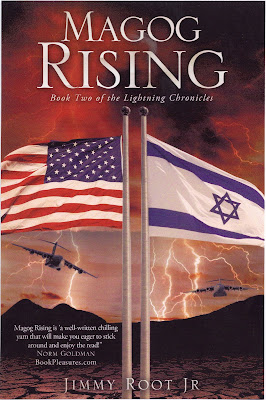
$15 per Copy...SIGNED!
Buy several for the same shipping rate as ONE! Give them as gifts.
OR
Send a check to Jimmy Root Jr PO Box 112, Smithville, MO 64089
(add $5.00 for shipping)

MAGOG RISING
is the READERS FAVORITE 2010 National Writing Competition SILVER MEDALIST in the Christian Fiction Genre
ORDER NOW
Visit:
http://www.lightningchronicles.com/
Toll Free at 1866 909-2665
Or use the above address to send a check for $18.00 (includes shipping) and ask for Magog Rising...or get both books....SIGNED!
, , , , , , , , , , , , , , ,

Thursday, February 24, 2011

Chapter Twenty-nine

CHAPTER TWENTY-NINE

Southern Lebanon
Wednesday, 11:35 p.m.

The impression persisted like an itch that just wouldn’t go away. General Telnikov could not get rid of the feeling that it was imperative that he head back to his headquarters on Mount Quarnat as Sawda. Years of training had honed his intuitive senses, but this seemed to flow from somewhere in his gut rather than his brain. He decided to listen.
“Lieutenant,” Telnikov spoke to the communications officer, “re-call my transport immediately. I am leaving.”
“Da General,” the man replied.
Telnikov didn’t linger to hear the call for the return of the helicopter gunship. Pulling on his outer jacket to stave off the night chill, the general headed for the door of the listening post.
Just then, another officer raised his voice in alarm. “General, we have incoming aircraft bearing 3-5-2 degrees and moving fast.”
Telnikov heard the heavy thumping sound. His chopper had arrived. “What type of aircraft and whose?”
“Eight Israeli F-15s sir.”
Radio my transport and tell him to turn on his transponder, now!” shouted the General, “and tell him to switch off all other radar.” He then opened the door and ran for the helicopter just as its wheels touched the hard surface of the ground.
The side door of the chopper opened and a crewman extended his hand to pull the General inside. He wasted no time. “Lift off and get us out of here immediately!” yelled to the pilot above the din of the aircraft’s screaming engine. Then he threw himself into the seat and strapped himself in. By the time he donned the headset the pilot was already twenty feet above the ground and accelerating forward.
Just as the pilot banked the big chopper over the side of Mount Herman’s western flank, the forward listening post exploded in a pulsating fireball. Telnikov knew the men inside had no chance of survival.
The pilot reacted instinctively by accelerating to attack speed and whipping the nose of the Hind around to allow his infrared tracking system to lock onto the heat of the Israeli jets.
“Do not fire,” Telnikov commanded the pilot. “Do not fire. Get me back to Quarnat at top speed.”
The pilot hesitated for just an instant.
“Pilot, do as I command,” growled the general.
Slowly the nose of the Hind dropped and the chopper pivoted in the direction of Bekaa Valley. As it turned, Telnikov saw a series of fiery explosion all along the Israeli/Lebanese border stretching to the east. The Israelis were demonstrating a vicious resolve to defend their country. He knew it was only going to become more violent.

Saudi Arabia
Same Time

Moshe could make out a dim glow ahead which meant he was now within the outer marker of the Saudi airbase. He took a deep breath and let it out slowly, more to focus his mind than to relax his body. He’d been in enough combat situations to trust his physical reflexes and reactions, but his mind had to be clear. He flexed the fingers of his stick as he prepared to disengage the autopilot.
Suddenly the air controller’s voice broke through the steady hum of his engine. “Dagger—Dog Pound—be advised an AWAC just came on line over Bagdad. That means activity over Iraq is probable.”
“Roger—Dog Pound—we are nearing our entry point into the target. Keep me up to speed.”
“That’s a go, Dagger.”
A hasty American pull-out from Iraq was nearly complete. But four squadrons of American FA-18 Hornets were still deployed in Baghdad to maintain control of the skies. They were the last thing Moshe wanted to be thinking about. The Hornets were not only piloted by the best fighter drivers the United States had to offer, the planes were also stealthy and fast. Hopefully, the Americans were only interested in watching the fireworks from a distance. But since the US had turned its back on Israel, and most of their forces had pulled out of the region, it was impossible to know what they’d do.
Focus in Moshe, he thought to himself. The lights of Hafar al-Batin were glowing just over the ridge in front of him.
Tracers suddenly began shooting up into the night sky at various angles.
“All flights,” Moshe radioed to his team, “we have Triple-A ack-ack. The Saudis know we’re here.” The systems were fired by soldiers without the aid of radar, meaning the accuracy of the defense was poor. But because they were firing twenty caliber bullets into the air, they were still dangerous for any hostile fighter jets that came into the line of fire.
“Frisbee, it’s time to play,” Moshe advised his wingman. “I’m going to pop over this ridge and start my attack run on the S-300 before it can spool up and fire. Dodge that ack-ack and follow me in. Take out whatever looks like trouble, but concentrate on finding the 300s.”
“Roger, let’s do this,” Rueben answered with his usual thrill for a fight.
Moshe reached down and pushed his keypad to disengage the autopilot. He then set his maverick into search mode while initiating his radar jamming system. He would have only one shot at the first S-300 launcher before it reacted to his presence. He wanted the vehicle destroyed and its operators dead before they could put a missile onto his heat signature.
The ridge was coming up fast and was just over five hundred feet above the desert floor at its crest. Moshe pulled on the flight stick and cleared it by twenty feet. Hafar-al-Batin stretch out before him from left to right at two miles distance. He threw his throttle forward to full military power and scanned for a route to thread the Triple-A platforms positioned around the base. The AGM-64 Mavericks under his wings were scanning for the S-300 like a hunter sniffing out his prey. He could hear the low growl in his headset.
Flak fired skyward directly in his path, forcing him to tweak the flight stick to the left. Just then the growl in his ears turned to a steady, high-pitched tone. The Maverick had locked on a launch radar. Moshe fired his first weapon and turned parallel to the airbase runway. If his guess that the S-300s had been situated in a star pattern around the base was correct, he would be heading directly towards one now. He waited only three seconds before his second Maverick captured the target. Moshe immediately thumbed the stick to fire the weapon. The Maverick shot from beneath his wings and flew right over the top of a large structure on its way into the darkness.
At that moment he noticed the fiery exhaust of two fighter jets barreling down the runway. Saudi F-16C Falcons were launching into the sky. Another pair was maneuvering off the breezeway and onto the runway to follow their fellow fighters.
Moshe switched to his AIM-120 Sidewinders and waited for a tone. Once he got it, he fired two missiles.
“Frisbee, two Falcons are lining up on the runway. Burn ‘em!” Moshe ordered his wingman.
“They’re mine,” said Rueben.
Bright fireballs blossomed less than two miles off the end of the runway. The first set of Saudi Falcons had been destroyed.
Moshe glanced out his canopy toward the tarmac as he swept over the base. Multiple Falcons were armed and preparing to launch. Pulling a hard turn he cut loose on the Saudi aircraft with his canon. He felt like he was doing target practice in a simulator. The Saudis were sitting ducks. Each hit made by an incendiary round resulted in an explosion. In just one sweep of the field he had destroyed, or rendered inoperable, most of F-16s on the base.
Moshe maneuvered to his right and attacked three mobile Triple-A gun units. As of yet, no S-300s had locked onto his signature, nor had his threat warning sounded beyond a chirp. He was aware of a dangerous characteristic of the S-300. The missile had the ability to scan for targets while it was in flight. All an operator had to do was launch. The technology built into the infra-red system of the 300 did the rest. This was a major advance over the American-built Patriot system that required a radar lock with the bogey before it was fired. However, the more immediate danger was the Triple-A guns.
Moshe threw his stick hard to the right and curled back toward the base. Two more guns were placed at the western corner of the field and were firing in all directions. He triggered his canon and walked a steady stream of 20 millimeter rounds into the targets. Two more guns were out of action. With another twitch he brought the Lightning around the west and began to hunt for another S-300 emplacement.
“Frisbee, come around from the east and take out the Triple-A in that quadrant of the field. I’m going hunting.”
Just as Moshe glanced down at his Horizontal-Situation-Display, Rueben’s panicked voice sounded over the radio. “My threat warning just started screaming. I’ve got a 300 locked on my tail.”
“Start pumping chaff and get over those fires on the base,” shouted Moshe. “Lose it in the heat.”
Moshe’s threat warning was still chirping but had detected no missile lock on his Lightning. How long that would last he had no way of knowing. One thing was certain. He had to find and attack the other two launchers or both he and Rueben were as good as dead.
Jimmy Root Jr
Author: DISTANT THUNDER and the AWARD WINNING MAGOG RISING
Books One and Two of the Lightning Chronicles

$15 per Copy...SIGNED!
Buy several for the same shipping rate as ONE! Give them as gifts.
OR
Send a check to Jimmy Root Jr PO Box 112, Smithville, MO 64089
(add $5.00 for shipping)

MAGOG RISING
is the READERS FAVORITE 2010 National Writing Competition SILVER MEDALIST in the Christian Fiction Genre
ORDER NOW
Visit:
http://www.lightningchronicles.com/
Toll Free at 1866 909-2665
Or use the above address to send a check for $18.00 (includes shipping) and ask for Magog Rising...or get both books....SIGNED!
, , , , , , , , , , , , , , ,

Tuesday, February 22, 2011

Chapter Twenty-eight

CHAPTER TWENTY-EIGHT

The Fields of Nazir
Wednesday, 10:30 p.m.

The men were gathered in the hall when Hannah Lira entered and approached the podium. There was little doubt as to what the meeting was about. Although no other rockets had landed anywhere near the facility, it was obvious that Israel’s security situation was intensifying exponentially. Ben figured the next stage of prophetic fulfillment had probably arrived.
“Guys,” she began with a smile, “I want you to know you are making great progress in your training. Personal fitness has improved dramatically for every one of you, as has the scores in marksmanship and two-man tactics. I expected nothing less. However, I imagine some of you are feeling some aches and pains in your bodies.”
Hannah’s statement was met with various levels of groans and animated rubbing of muscles. More than anything, the men were just tired.
“As you can tell, bad things are happening all around us,” she began. “The numbers of Scud and Zelzal missiles that have been fired upon Eretz Israel is astounding. In fact, defense intelligence fouled up in its estimates by at least half. The number is approaching one hundred ballistic missiles in only two nights, and this night is only half over. Add to that the approximate six thousand smaller rockets fired from Lebanon and Gaza and you have quite a fireworks display going on. The miraculous thing is less than two hundred casualties have been reported in the attack so far, and all of those have been relatively minor. We have yet to hear of any deaths.”
The mood in the room changed for the better. No team member had been exempt from worrying about family and friends. Hannah felt them react to the news. “I haven’t told you this before now, but we have people keeping track of each one of your family members.” She looked right at Ben. “For some of you, that includes your close associates. All are safe. None have been harmed. I believe, with all my heart, the Lord is watching over them.”
Expressions of gratitude came from all around the room. Everyone was relieved, which was exactly the effect Hannah desire to create.
“Now, here’s the big news. The government has been pushed to act with overwhelming force. As I informed you last evening, the IDF had planned to launch an operation into Syria. I felt it would trigger the prophecies spoken in Psalm 83. Well, it seems the nations of Psalm 83 have beaten us to the punch.”
Ben looked at Gilad with a question on his face.
“Within the last two hours Saudi, Jordanian, and Egyptian fighter jets have gone head-to-head with the IAF.” She turned to the map behind her and pinpointed the where the confrontations had taken place. “Once again, we have no word that any Israeli aircraft was lost in these initial battles. But, from what I’ve been able to gather from my sources, there were some very close calls.”
Ben was certain Moshe would have been in the latter category. It seemed his new brother in Messiah had a knack for being in the thick of every hot spot. He was compelled to offer a silent prayer for his friend.
“On the surface this all looks bad, but there are a couple of good aspects for which we need to be thankful. First, Israel now has a legitimate reason to go on the offensive. Up until the moment enemy aircraft became aggressive, all the IAF was doing involved search-and-destroy missions against the scuds. Operation Pile Driver, that’s the push over the Golan Heights, had not yet been initiated. Second, because the surrounding nations have all moved under the Iranian umbrella, the rest of the world will see that Iran has double-crossed the Russians. No one will blame Israel for doing what it must do.”
Ben thought about it from a Biblical point of view and had no trouble guessing what was coming next. It was as if the nations surrounding Israel had put a gun to Jewish heads and were about to pull the trigger. But God was the master manipulator in everything that was happening. Ben knew the thought sounded negative, but if God was really in control as he said, then nothing was happening without his permission. A long awaited judgment was at the doorstep. Even now, Ben knew that the Lord would be giving the civilians of those nations an opportunity to repent and turn to the truth of Yeshua. Would they? That was the question.
“What will Israel do?” one of the men called out.
“All I can say is that by tomorrow morning, the inner ring we were talking about will be subdued,” Hannah stated. “What is about to happen will make people consider the temporary nature of human existence.”
“Dear Lord,” Gilad whispered. Everyone heard it.
“Amen to that,” said Hannah. “Now, a concentrated attack is set to begin within the hour. That means we are going underground for the rest of the night. When we come out of our hole tomorrow, we will continue our mission preparations in earnest. I told you our timetable was being moved up. Well guys, we have no more than one week to get ready. Get your heart and your head into the game. We are fast approaching the point of no return.”

Husifa
Same Time

The gathering was over. Ty had done his best to introduce hope into the lives of the group. He’d taken them through scriptures of solace. They’d prayed together for much of the evening. A bond was forming. But now, twenty minutes after Tasha had escorted him and Blake to one of the many private quarters in the shelter, he heart was apprehensive.
Blake noticed.
“What are you thinking so hard about, sweetie?” She was curled up next to Ty with her head lying on his lap. Even with her eyes closed she could feel the wheels of thought churning in his mind.
Ty chuckled. “We’ve only been married five days and you can practically read my mind.”
She turned her body so she could look up at him.
He brushed aside a few strands of long blond hair away from her face.
“Hey, buddy, our spirits are knit, remember?” she smiled. “Plus, it’s my right to read your mind. So, what’s going on in there?”
He took a deep breath and sighed. “I’m asking myself if we did the right thing in coming here.”
“Why?”
“I suppose it’s because I figured this would be the safest place to be as things unwind. Instead, we’ve spent the last two nights in a bomb shelter,” he shook his head. “Not so safe after all, is it?”
“No, but from my perspective, it sure is cuddly.” She smiled at him.
“You know what I mean,” he smiled back. “I’m wondering if we missed God on this one.”
His statement made Blake sit up and intertwine her fingers into his.
“I think if I had a choice between this and living through radioactive fallout in Kansas City, I’d choose being here. I’m also of the high opinion that wherever you are, that’s where I want to be.”
“I guess the last thing I want to do is put you in danger.”
“You know I love you, but you are not the one ordering our steps,” she leaned over and kissed him on the cheek. She was deeply gratified that her new husband was thinking solely for her safety. His protective responsibilities had kicked into gear.
He shook his head and raised his eyebrows for a second. “Yeah, I suppose,” he acknowledged.
“No, you know!” she nudged him. “The steps of a righteous man are ordered of the Lord. We’re here for a purpose. There is no way in the world that I think you made a wrong decision on this one.”
He kissed her soft lips and soaked up her confidence.
“You understand this could get rough, don’t you?”
“Sure. ‘Bring it on’ is what I say. The way I see it we’ve got a mission to accomplish. Let’s go into to it full bore.”
“Okay, then,” he stated. “We’re going to be in here all night. Let’s get some rest.”
“Okay, then,” Blake echoed.
Her head went right back to his lap and she was asleep before he could take his eyes off her beautiful face.

Over Saudi Arabia
Wednesday, 11:30 p.m.

“Stay sharp, Frisbee. We’re two hundred miles from King Khalid Military City, and hopefully, the Heron Drone has done its worst. I’m getting radar returns that indicate it has gone back to high altitude.
“I see it too—Dagger.”
The Heron TP unmanned drone had been on station and in attack mode for at least an hour. Its mission had been to seek out and destroy as many S-300 missile launchers it could find. The stealthy drone aircraft, roughly the size of a Boeing 737, was being flown by some computer geek back at Ramon Airbase, one who had demonstrated an uncanny ability to play video games. The only difficulty was finding the S-300s without having them engage their defensive radar. The Arabians had to be shocked watching their vaunted Russian system being eaten up by a piece of Israeli technology.
“A squadron of Arabian F-16Cs will probably be appearing shortly,” said Moshe.
Rueben responded with two clicks on his transmitter.
Dagger Flight was skirting the desert floor at an altitude of two hundred feet. They were barely one hundred miles south of the Iraqi border. This particular aspect of the mission was to perform a coordinated strike with six F-15 Ra’am ‘Thunder’ fighters by sniffing out the locations of as many anti-aircraft missile batteries as possible. Destroying every S-300 within their designated sector was the objective. Dagger flight also had the responsibility of countering and eliminating any aerial threat.
The entire Northern Command of the Saudi armed forces was deposited within the confines of two facilities. The largest was housed in King Khalid City. An armored brigade and its supporting units were also housed on the base. The anti-aircraft batteries that protected it would catch the brunt of the F-15 strike.
Sixty miles northeast of King Khalid was Hafar-al-Batir airbase, home to two squadrons of Arabian Air Force F-16C Fighting Falcons. Situated in various locations around the base were an unknown number of S-300 mobile launchers. They all had to be taken out. The task belonged to Dagger Flight.
Moshe monitored his display and mentally prodded himself to stay alert. The day had already proven to be extremely long, but Israel was at risk. The nation’s existence seemed to be balanced on the sharp edge of a knife. Everything that was happening was to save her and her people. Rest was a luxury Israel’s defenders simply did not have.
The flight crossed the one hundred mile barrier at an airspeed of mach one. Showtime was imminent. Moshe thought through the variables one more time before he initiated the plan.
“Frisbee, check right and widen to one mile.”
“Roger, Frisbee is moving south by one.”
Moshe prepared to disengage the autopilot and terrain following radar. Once that was done, he would make a quick ascent to an altitude of four hundred feet to get a fix on any remaining Saudi air defense systems. If the drone had done its job, there would be few. He would then drop back down to the deck and prepare for a welcoming committee comprised of infrared-tracking missiles and standard anti-aircraft fire, called ack-ack. The action he was about to commit would alert the enemy to his presence, but it had to be done in order to pinpoint their objectives.
He checked Rueben’s position then widened his radar pattern until he acquired the six F-15s. Their group call sign was Jackhammer.
Moshe thumbed his transmitter. “Dagger—Jackhammer—we’re going hot in twenty seconds.”
“Roger—Dagger—make us some friendly skies,” Jackhammer One responded.
“Frisbee, concentrate your snapshot to the south. I’ll look to the north,” Moshe radioed to Rueben. “We’re going up on my mark. Three—two—one—mark.”
The F-16s, now separated by a mile, jinked up to four hundred feet above the desert floor, held the altitude for five seconds then dropped back under normal radar coverage. Immediately, threat receivers on both aircraft began squawking. Four anti-aircraft batteries were active around Hafar-al-Batin, less than a third of what intelligence had estimated would be present. The drone had proven its worth.
The computer took no time in identifying the radar signatures as S-300 tracking units. Several ZSU-track mounted anti-aircraft guns with an older model, wide-band radar were also detected. The ZSU-flak shooters could be dealt with relatively easily. However, Israeli jets had yet to attack any targets protected by the Russian-designed S-300 system. Each battery consisted of four launch canisters mounted on special vehicles the approximate size of a semi-truck trailer. The system was completely mobile and each battery could fire its missiles and be fully reloaded in less than ten minutes. Only stealthy aircraft had been proven successful against the S-300 and the F-16s possessed no stealth technology. Four batteries meant sixteen missiles were locked, loaded, and ready to kill.
“All flights,” Moshe alerted his fellow pilots as he dove toward the desert floor, “we have active S-300 radar in the vicinity of both objectives. Dagger will take the northern group. Jackhammer flight heads south. Watch your tails.”
Clicks sounded in his receiver and within seconds, Rueben was back into formation behind his leader.
Moshe and Ruben, now directly west of Hafar-al-Batin airbase, converged on a preprogrammed waypoint. After a ten degree right turn, a shallow wadi would be utilized to fly below radar all the way to the target.
As he nudged his fighter in the right direction, Moshe entertained a thought. Because of the drone’s search and destroy mission, it was likely that Arabian F-16s were already scrambling. That meant a certain degree of activity would be happening on the tarmac and runway. He could use that his advantage if he timed it correctly. “Frisbee, let’s drop speed to six hundred knots and give them time to get their Falcon’s moving,” Moshe said to this wingman. They were now just thirty miles out and that distance would be eaten up rather quickly, even at six hundred knots.

Jimmy Root Jr
Author: DISTANT THUNDER and the AWARD WINNING MAGOG RISING
Books One and Two of the Lightning Chronicles

$15 per Copy...SIGNED!
Buy several for the same shipping rate as ONE! Give them as gifts.
OR
Send a check to Jimmy Root Jr PO Box 112, Smithville, MO 64089
(add $5.00 for shipping)

MAGOG RISING
is the READERS FAVORITE 2010 National Writing Competition SILVER MEDALIST in the Christian Fiction Genre
ORDER NOW
Visit:
http://www.lightningchronicles.com/
Toll Free at 1866 909-2665
Or use the above address to send a check for $18.00 (includes shipping) and ask for Magog Rising...or get both books....SIGNED!
, , , , , , , , , , , , , , ,

Monday, February 21, 2011

Chapter Twenty-seven

CHAPTER TWENTY-SEVEN

Northern Israel
Wednesday, 9:30 p.m.

The two F-16’s gently touched the surface of Ramat David’s runway then proceeded to the protective bunker for rearming. Moshe pulled his aircraft into the brightly lit hanger and switched off his engine. Two large bay doors were slid shut behind him. Since the canopy was already extended into the air, all he had to do was to wait until the wheels had been choked and a ladder hooked to the plane. He quickly dismounted the aircraft, stretched his legs, and walked straight for the head.
Five minutes later he mounted a motorized cart and was driven through the underground maze to the headquarters bunker. Rockets were still falling in the area, so every aspect of base operations, besides takeoffs and landings, had gone underground. This would be the status until the current onslaught was silenced.
Colonel Natansky was waiting in a small briefing room. Seven other members of the squadron were already there, including Rueben, who still had a glassy look in his eyes after his most recent near-death experience.
“Colonel,” Moshe greeted his commander as he entered.
“Captain, get some coffee and take a seat.”
Moshe helped himself to the stout brew then sat at the table beside his wingman.
“You guys flew into it tonight, didn’t you,” the colonel began. Laid out on a table before them was a large, detailed map of the region. “You’re not the only ones. We’re having confrontations across the board. By the way, tonight was the first time an F-16I ever faced an F-2 Typhoon. Considering the odds, I’d say we came out of it much easier than we thought possible. Well done.”
Rueben rubbed his hand his face from forehead to chin, “I’d say our kosher dills about got pickled, Colonel. Was there no warning that the Saudi’s would send up their fighters?” He was exhibiting the same irritation felt by his squadron leader.
“If you’ll remember, we talked about that possibility. The Arabs and Egyptians decided to get
involved after all.”
“What numbers are we dealing with?” Moshe asked.
“The Saudis put up two dozen Typhoons, and it wasn’t a last minute operation. IDF intelligence believes it was planned to coincide with our response to the Scud launchings.” The colonel pointed at the map toward the lower portion of the Negev near Israel’s border with Egypt. “Those guys sent up a mixture of Mirage 5 and F-16C fighters. We think it was a faint, something to distract the 104th out of Ramon.”
“What makes you say that?” Moshe asked.
“Because they never crossed the buffer zone into Israel. Two of our Lightnings were able to chase them back to the Pharaoh,” Natansky answered.
“I’d say the whole picture smells rotten,” Rueben said bluntly. “We’re getting fired on without provocation, and now everybody wants to get in on the action. I don’t get it.”
Moshe looked at Rueben and wondered if the kid was just about ready to hear the truth. If the moment hadn’t arrived, it was certainly on the way.
Natansky continued. “You best get used to it. This thing is only going to get worse tonight. Right now we have sixteen aircraft engaged against three times their number, and that stretches from Syria to Saudi Arabia. The Jordanians, Iranians, Syrians, and Saudis are coordinating their attacks. They are attempting to draw us away from the Scuds and Shahabs.”
“They’re still firing?” Moshe was incredulous.
“Yes, they are, but not to worry,” said the colonel. “Two squadrons of F-15s out of Tel Nof are doing a bit of search and destroy. At last report, the launches were fewer and farther between.”
Moshe had not yet asked, but the question had been on his mind all evening. “What about the rockets coming out of Lebanon and Gaza?”
“All I can say is we’ve made a dent there as well,” answered Natansky, “but they are still firing at whatever they think they can hit.” The colonel knew what Moshe and the other pilots were thinking. Most of them had family at risk, especially since the longer-ranged Fetah-110 rockets were being used. “But I’ll be honest. Everything from Haifa to Tel Aviv is being targeted. The good news is civilian casualties are incredibly light. We’ve got to make sure it stays that way.”
“What will be the plan?” asked another of the pilots.
“Order’s have just come down from headquarters. Operation Pile Driver will begin within the hour. However, another operation has just been initiated. It is called, Clean Slate.”
“Does that mean what I think it means?” asked Rueben.
“Probably more. Clean Slate will utilize a three strand approach. The first strand will be to launch a simultaneous attack against enemy air assets in Jordan, Syria, and Saudi Arabia. That means an attack will be initiated by both manned aircraft, and unmanned drones. We will also achieve air superiority through air-to-air combat.” Colonel Natansky then drew a line on the map with his finger beginning in Beirut, Lebanon and sliding all the way to Amman, Jordan. “The second strand will involve the use of High Impulse Thermobaric explosives, or HITs for short. At least two waves of HITs will be dropped over Jordan and Lebanon. The Gaza Strip and portions of the West Bank will also be targeted.”
“Oy vey!” whispered Rueben. Thermobaric weapons were outlawed by the Geneva Convention. The reason was easy to figure. HITs had the effect of a tactical nuclear weapon, but without the residual radiation. They utilized a pre-determined altitudinal release of a high explosive mist over the target. A small, secondary charge then ignited the fuel and the surrounding oxygen. The effect was an enormous fireball, followed by a massive shockwave. People in the blast zone were vaporized. All buildings would be flattened.
“That’s not all,” Natansky said as he slid his finger toward the Arabian Peninsula. “The last strand of the operation will involve a salvo of nuclear tipped cruise missiles. Along with them will be several Jericho IIIs. Arabia and Egypt will be turned into a wasteland. Your little part of the mission will be to minimize the numbers of S-300 anti-aircraft missile that are parked around King Khalid Military City and Hafar-al-Batin airbase in the north. In other words, you have to clear the way so that the Jerichos can get through.”
Moshe shook his head in disbelief. The Jericho III had a range of nearly eight thousand miles and carried multiple-independently-targetable reentry vehicles, called MIRVs. Each warhead delivered a nuclear yield of anywhere from three to ten kilotons. But it wasn’t Israel’s exertion of force that shocked him. Rather, it was seeing the prophecies unfold right before his eyes, prophecies he been taught within the last three days. What Ty described as the ‘inner ring’ nations were about to be turned into toast.

Central Lebanon
Same Time

General Telnikov directed the pilot of the Hind gunship to carry him from one side of Lebanon to the other. All along the border rocket fire was being met by smart bombs. As the helicopter moved on an eastward track, he could see that neither the Israelis nor the Hezbollah were slacking off in intensity of the attacks. By the massive blasts being generated, Telnikov could tell the Israeli Air Force was utilizing 500 pound guided munitions, most of those being fragmentation bombs designed to kill and destroy well outside the impact point. But the number of rockets shooting through the skies toward Israel demonstrated that little progress was being made, at least in this sector.
He leaned to the center of the chopper and looked for the time indicator to the right of the pilot’s console. He could hardly believe they’d been airborne for an hour. The sights and sounds of war still had the effect of slowing him down in time. Mostly he was amazed that the current escalation of hostilities over Jordan and Saudi Arabia had not yet spilled into Lebanon. After all, it was through Hezbollah and Hamas that Iran was exacerbating the current crises.
Just then, the voice of the communications officer broke into the Telnikov’s musings. “General, our forward post in Chebaa is reporting increased armored movement within Israel.”
One of the first operations carried out by the Russian 7th Armored Division had been to establish an electronic listening post on the slope of Mount Herman. Situated high above the city of Chebaa, the position provided the ability to monitor ground positions and movements of the combatants. Everything from the Golan to the Mediterranean Sea was visible by radar.
“Where is the activity?” barked the general.
“The operative says Israeli tanks are coming out of bunkers in mass. They are moving into the Golan Heights.”
“Pilot,” Telnikov ordered, “turn this thing around and head for the Golan, but make no threatening moves. I want a parallel course to the border all the way to the post.”
“Da, General.” The Hind banked hard to the right and proceeded to transport the general into the danger.
Fifteen minutes later the helicopter flared and landed on a flat shelf on the side of Mount Herman. With a thumbs-up, the pilot signaled the general that it was safe to dismount and move to the protection of the small container-sized. The chopper lifted off the second Telnikov was clear of the rotors. The asset was too valuable to leave exposed to a mortar fire.
Telnikov opened the door and poked his head in the narrow doorway of the communications trailer. Four members of the Russian 7th were seated before a long panel that provided several video monitors and audio enhancers. High resolution, night vision capable cameras were perched on top of the trailer and provided video feeds of the Golan slope.
A corporal, seated at a console, turned to Telnikov. “Please take a seat, General.”
“Tell me what you have found, Vitally,” Telnikov said as he sat beside the operative.
The corporal pointed to a large monitor.
“Sir, this camera is pointed at the center of the Golan Heights about eight kilometers from this location.” The screen was black. The corporal switched the monitor into infrared mode and the site caused Telnikov to take a quick breath.
The heat signatures of at least sixty Merkova Mk IV main battle tanks, in cadres of six, stood out from the darkness. They were making their way up the slopes of the Golan Heights. Following each cadre was a group of MDT David light armored vehicles intermixed with several Namer troop carriers. It was difficult to distinguish between tanks and troop carriers, thus adding to the chilling effect that Israel’s entire Golani Brigade was moving toward Syria.
Just then another soldier at the other end of the trailer shouted. “We have six Longbow aircraft bearing down on our position.”
Telnikov got up and moved to the man’s side so he could see the radar signatures. Sure enough, six Israeli ‘Saraf’ attack helicopters were changing course and flaring up the side of Mount Herman. They were coming straight toward the listening post.
The soldier looked up into the eyes of the general. Telnikov knew what the kid was thinking. The Saraf was an upgraded version of the American AH-64D Apache Longbow, and it was nothing less than fast and deadly. The question was whether or not these Sarafs had a deadly intent in their approach. Telnikov knew that exiting the trailer was useless. Not only could the Sarafs destroy the trailer from long distance, they could also vaporize any human targets in the
area by utilizing their M230 chain guns. That made the decision a non-starter.
“Don’t worry,” the general said as he placed a hand on the soldier’s shoulder. “If they wanted to kill us we would be dead already.”
Immediately the roar of six turbine engines roared over the listening post and off into the night sky.
“Shall I report to Moscow, General?” asked the communications officer.
Telnikov almost gave the order, but a thought brought him up short. The Iranians have brought this upon themselves. If I were in Israel’s place, I too would perform a blocking action against that madman. Israel is making no threat to the other members of the coalition. He came to his decision.
“Have any of our other posts detected this movement?” Telnikov asked.
“Nyet, General.”
“Very well. Israel just wants the Iranian to consider the consequences of his actions. Send no report, and make no reference of this to the other posts until first light,” Telnikov ordered.
“Da, General.” The operative glanced at his comrade in the next chair and ever-so-slightly raised his eyebrows.

Ramat David Air Base
Wednesday, 10:15 p.m.

“Okay, Captain, what is going on?” Rueben sat down on the couch beside his squadron commander then slid into a semi-reclined position.
Moshe’s squadron was thirty minutes away from pre-flight preparations for their assignments. The original mission of assisting in Operation Pile Drive by flying high-altitude cover had changed. Operation Clean Slate was now the order of the night, and that meant extreme involvement in clearing the skies over Jordan and Saudi Arabia. Following Moshe’s Lightning squadrons would be the F-15 Thunders loaded to the hilt with earth-pounding ordinance. The enemy had better be tucked into a hole.
Moshe’s hands were clasped behind his head when Ruben sidled up to him. He understood an important moment had arrived, one he’d been silently praying for since their shift had begun that afternoon.
“Remember the other day when I told you these things had been written beforehand?” Moshe asked.
“Yeah, that prophecy mumbo jumbo,” Rueben nodded.
“Not so mumbo jumbo now is it?” Moshe figured he might as well be straight forward.
“I guess not. Tell me more.”
“Our little prophecy talk revolved around what the Russians and Iranians are doing, but there is more. Do you remember that American couple we saved from the Turks last week?”
“Yes.”
“Well, he is the guy who is stepping in for the preacher at my wife’s church.”
“What happened to the other Rabbi?”
“That’s the crazy part,” Moshe said. “He told me about a special operation he’d signed up for; one I wish I could tell you about. I can’t.”
“So, you’re not telling me anything, but the man is probably doing something that is connected with tonight’s activities, right?” If nothing else, Rueben was astute. “I suppose he told you about everything the prophets said.’
“That’s just it. He didn’t teach us any prophecies from the Torah that dealt with this exact scenario,” Moshe confessed as he dropped his hands to his thighs.
“I thought you said this was all written before hand,” Rueben stated.
“What I’m saying is Pastor Ben had no idea. The American found it. He showed the whole thing to us last evening. Believe it or not, he took us to some passages in the Torah that predicted precisely what we are about to do.”
“Really?” Rueben exclaimed. “I won’t ask where. I haven’t read anything in the Torah since my bar-mitzvah. Just tell me what it said.”
“Five different prophets named the nations and what would happen. The time frame of their destruction is given as well.”
“What do you mean?” Rueben asked.
“They all give a general reference about a time after Israel is restored as a nation. From there, the prophets cited Lebanon, Jordan, Syria, Saudi Arabia, Egypt, the Gaza Strip, and the West Bank. Two of the prophets said the destruction of those nations would happen from the evening to the morning…in other words, one single night; one single event.”
Rueben rubbed his hands over his face as he tried to absorb what he was hearing. Moshe sat quietly and waited.
Finally, Rueben asked the question Moshe had been hoping for. “Why? Why would that stuff be written like that? It seems like God, if there is one, is saying; ‘this is going to happen and there’s not a thing you can do about it.’”
“I think you’re partly right,” Moshe nodded, “but there is another reason. He gave it to us as a proof.”
“What kind of proof?”
“Well, for one, proof that he exists. For another, we have proof that every other thing he said is also true. In other words, the prophecies are not just warnings. They form a personal call to everyone who will listen.” Moshe paused to see if Rueben was tracking with him.
Rueben waved his hands in front of him as if to say come on, give me more. The young pilot’s life had been threatened enough over the last few days to give him a sense of his own mortality. He was no longer in the mood to clown around.
Moshe breathed a prayer that God would make his next few words sink into Rueben’s heart.
“You see,” Moshe continued, “this thing is winding down to some sort of an end. The Torah explains what the end will look like, and these prophetic events are proof that we are getting close.”
“Close to what?”
Moshe figured he’d come this far. His only option was to take the plunge and let God sort it all out for his wingman. If Rueben’s faith was going to be ignited, it would happen in the next few minutes. He laid it all out, including the plan of salvation he had received from Ben.

Jimmy Root Jr
Author: DISTANT THUNDER and the AWARD WINNING MAGOG RISING
Books One and Two of the Lightning Chronicles

$15 per Copy...SIGNED!
Buy several for the same shipping rate as ONE! Give them as gifts.
OR
Send a check to Jimmy Root Jr PO Box 112, Smithville, MO 64089
(add $5.00 for shipping)

MAGOG RISING
is the READERS FAVORITE 2010 National Writing Competition SILVER MEDALIST in the Christian Fiction Genre
ORDER NOW
Visit:
http://www.lightningchronicles.com/
Toll Free at 1866 909-2665
Or use the above address to send a check for $18.00 (includes shipping) and ask for Magog Rising...or get both books....SIGNED!
, , , , , , , , , , , , , , ,

Sunday, February 20, 2011

Chapter Twenty-six

CHAPTER TWENTY-SIX

Jerusalem
Wednesday, 8:35 p.m.

General Ehud Katz, commander of all IDF forces, stood before Prime Minster Yosef Naftali. A few members of the Cabinet were there as well. “Yosef, this is the scenario that I’d warned you about. Every one of our neighbors has joined the attack.” Katz and Naftali were long time friends and political allies.
“How is the population holding up?” asked the Prime Minister.
“Reports are coming in from the length and breadth of Eretz Israel,” Katz began. “The Patriot batteries were expended in the first thirty minutes. There are simply too many missiles being launched. The IAF was having success hunting down and destroying the mobile launch platforms in Syria and Jordan, but that ended when enemy aircraft filled the sky. All our assets are now fully engaged in a battle for air superiority.”
“But what of the population?” Naftali repeated the question with a hint of irritation that it hadn’t been immediately answered.
“Impacts are being reported nationwide. Some have gone astray to strike Gaza. There is no way to know what the casualty figures are, but several Scuds and Shahabs have hit within heavily populated areas,” answered the General.
“Has there been any lessening in the rate of the launches?” asked a member of the Cabinet.
“Not since the moment the IAF went into aerial combat mode,” said Katz. “But that isn’t the only problem. Long range radar shows Royal Air Force activity taking place over Riyad, Danbu, and Rub al Khali. The Saudis are serious. The same goes for Egypt. They are sending up mostly F-16 and Mirage F-5 fighters.”
“What numbers are we looking at?” asked Naftali.
“If you are asking if we have the forces necessary to repel the current enemy numbers involved in this confrontation, the answer is yes,” Katz explained. “We have two hundred thirty-two F-16s with duty-ready status, and roughly fifty-five F-15s that can be launched. However, I suggest we task our F-15s with seek-and-destroy missions against enemy missile platforms.”
“I agree,” said Naftali. “Give the order. How long can we maintain these numbers in a sustained fight?”
“Sir, we were preparing to initiate Operation Pile Diver tonight. In other words, the entire force was placed on either alert or operational status as of sundown. We can keep up the fight for at least twenty-four hours. Beyond that, it will depend on our losses, as well as the numbers of fighters the enemy assigns to combat.”
Naftali looked up and directly into the eyes of General Katz. He wanted a truthful answer to the question he was about to ask. He knew Katz well enough to be able to see his response without the man uttering a word, but he wanted to hear it anyway. “If they throw up everything they’ve got in their arsenals, can we beat them?”
Katz returned the gaze and answered without emotion. “Yes, but that is not the problem.”
“You speak of the Russian coalition, do you not?”
“I do,” the General nodded. “We cannot fight the entire Arabian and Egyptian Air Forces and expect to hold off the Russians if they decide to overrun our country.”
Naftali rose from his chair and went to his desk. On it was a single sheet of paper that required three signatures. A protocol had been established years earlier for just such an occasion. The protocol had never been used, not since Israeli scientists had learned to split the atom.
The Prime Minister picked up a pen and bent over the paper knowing that Israel’s release of two nuclear weapons over Damascus was nothing in comparison to what he was about to unleash. Closing his eyes tightly and taking a deep breath, Yosef Naftali signed the order. His signature followed by the opposition leader in the Knesset, and then by General Katz.
Before the General left the room Naftali completed his order. “I want every brigade moving by dawn. Do you concur?”
“I do, Yosef,” Katz answered. “This is our only option if we are going to save Eretz Israel.”
And then, as he looked at his friend who appeared to have aged in a matter of minutes, the commander of the Israeli Defense Forces saluted his leader.

Over Western Saudi Arabia
Same Time

Moshe had no difficulty choosing targets for his four AIM-120 AMRAAM missiles. There were eight Typhoon fighters coming head-to-head with him and Rueben. Two other flights of eight had broken off to the right and to the left, evidently to engage his fellow Israelis. It was show time.
Now within the AMRAAMs thirty mile range, Moshe designated the two lead planes, waited for the steady growl in his headset, and then fired the weapons. The instant the missiles shot out from under his wings he was tugging on the stick to gain altitude while giving his jet a few seconds of afterburner. “Dagger—Fox Three—Fox Three,” he called the shot.
Rueben, less than three miles off Moshe’s wing to the south, fired two more AIM-120s then followed his leader in a maneuver that would attempt to catch whatever Typhoons came their way once they scattered. As the Saudis had not yet fired, it stood to reason that they were armed with a shorter ranged little devil called the ASRAAMxl. The missile was an infra-red, heat seeker that had a range of nearly fifteen miles and could fly at Mach 3. The Israelis had tagged the missile with the name “Slicer” for its ability to cut through jamming clutter and home-in for the kill.
“Frisbee, we get one more shot at this before they come to bear with their Slicers,” Moshe transmitted.
“I’m with you, boss.”
Moshe noticed, by scanning his HUD, that the group that had broken off south were doing what he’d suspected. The Typhoons were going low and coming around in an attempt to trap the F-16s from behind.
“Let’s go to full military power and keep those birds off our tails a bit longer,
Frisbee,” Moshe order. Two clicks sounded in his headset.
He watched his display as the forward Typhoon formation, now less than twenty-five miles distance and closing, smoothly broke and began their evasive tactics. The Slammers would not let their targets off the hook very easily, and sure enough, within less than thirty seconds, four planes were eliminated from the fight. Moshe checked his weapons inventory and saw he was down to two AMRAAMS and four Sidewinders.
Two F-2s regrouped twenty-four miles away. They were below his altitude and to his right. The planes had gone into ‘supercruise’ mode and were spreading to attack at a speed of Mach 1.1. The Typhoon had the ability to sustain that velocity for several minutes without going to afterburner, thus expending less fuel than the F-16s.
Just as Moshe was preparing to lock onto them with his Sidewinders, the Saudis took a sudden dip behind a low ridge. The enemy planes were stealthy enough to keep his radar from giving them a full electronic interrogation. At the current rate of closure he would be on top of them in no time at all.
Moshe lined the nose of his lightning with the exit point of the valley and tasked two of his Sidewinders into search mode. He then dropped his airspeed in order to give himself the ability to maneuver if necessary, yet keep the Typhoons in his windscreen.
Just then, Rueben broke the silence. “Dagger—we’ve got company at our six.”
Moshe looked at his HUD. Two more blips of the original eight disappeared from the screen telling him that Rueben’s Slammers had done their damage. The others were bugging out. However, eight bogeys were gaining on them from the south. “Frisbee—pull off and take them on. I’ll drop these last two birds and join you, but be advised I’ll be down to my last two Sidewinders.”
“Roger—Frisbee is flipping.” Rueben took his F-16 to inverted flight and whipped a hard turn to face the oncoming Typhoons.
Moshe slowed the Lightning even further as he anticipated the appearance of the Saudis at the southern end of narrow depression. He involuntarily re-gripped the flight stick as the two Typhoons shot skyward from the wadi. Gently tracing their upward movement with the nose of his plane he pushed his throttle forward and fired his Sidewinders. Just then, the threat warning began to sound. He saw the reason. Both Typhoons had released their Slicers, and the killers were turning sharply in the hunt to acquire his heat signature.

Husifa
Wednesday, 8:40 p.m.

No one said a word. What happened next seemed as natural as breathing. Everyone in the circle rose and went to Tasha. The entire country was being hammered by rockets from across every border, but everyone in the room knew that Tasha’s husband would certainly be facing the greater threat. In the shelter, their lives were safe and secure. His wasn’t, even though he was one of Israel’s most experienced and victorious pilots. What moved them most was the knowledge that Moshe was now one of their own. He was a brother in Yeshua who needed their intercession. Tasha was his wife. Therefore, she became their point of concentrated faith.
Hands were placed on her shoulders as she sat in the chair. Ingrid took one of Tasha’s hands in hers, Blake took the other. All heads bowed, and lips began to silently move as the group prayed for the safety of both their friend and his fellow pilots.

Over Western Saudi Arabia
Same Time

Moshe knew the Saudis were dead. He also knew the short distance between he and the firing point of the Slicers made it probable that he would soon be dead as well. With a push of the throttle into full military power, a jerk of the stick to the left, and the application of the ailerons, Moshe rolled his fighter and made a hard turn away from the oncoming missiles. Chaff and burning flares were ejected from the tail of the aircraft. He then pulled right on the stick to minimize the heat signature of his power plant. Both Slicers homed in on the heat of the flares and exploded less than two hundred feet behind him.
With a short intake of air, Moshe continued the right hand turn toward the south and punched his afterburner. Rueben was just over five miles ahead of him in his attack on the oncoming Saudis. The smart thing to do would be to bug out for home rather than engage. He was out of missiles. But his wingman was going to need his help, at least the presence of his Lightning to give the Saudis something else to worry about. Moshe saw he would catch up quickly, but fuel would be expended to a point in which he would only have a few minutes to engage the enemy before he was forced to turn for home. Would there be enough fuel and weapons to keep from being shot from the sky? That was the question.
“Frisbee—I’m hot on your six. I’ll be coming up on your right in twenty seconds,” Moshe radioed to his wingman.
The bogeys suddenly split into four pairs, each taking different tacks outward from a presumed center point. Two pairs went high, two went low. They appeared to be attempting to come at the two F-16s in a three dimensional attack formation.
This is not going to be pretty, Moshe thought to himself, and then he whispered a prayer. “We could use some help, Lord.”
With no remaining long-range AMRAAMs, Moshe would have to work his way into their kill zone before he could fire his cannon. He quickly punched the Horizontal Situation Display, located above his left knee, into terrain mode. Through his night vision equipment, only flat desert appeared between him and the inbound enemy. They were now crossing the thirty mile barrier. What he needed was an obstacle, something to get into and fly by the seat of his pants, something he could use to break his radar signature. Suddenly, there it was. A range broken by wadis and ridges loomed a thousand feet above the desert floor. It was located along the Arabian border with Jordan and it was only seven miles to his right. The decision was easy. In fact, it was the only option he had if he wanted to make it through this fight alive.
“Frisbee—I’m going to the right and low. There’s a grouping of hills that I’ll use. I’m about to pull a fast one on these schmucks.”
“Hey, don’t leave me hanging out here,” Rueben exclaimed.
“I’m not. Go high and west. Put some distance between you and the other three pairs,” Moshe ordered. “We’ll narrow the odds, at least for a minute or two. Help will be here in five minutes.” At least he hoped the alert fighters out of Ramon had shifted into high gear.
“On my way,” Rueben answered.
Moshe cut the flow of fuel to the afterburner and dove for the set of hills fast approaching at his two o’clock position. Seven thousand feet were eaten up in an instant. With the enemy Typhoons nearing the range of their AIM-132 Slicers, it was time to break up his radar silhouette.
A narrow gorge, protected by hills opened directly in front of him. They rose eighteen hundred feet above the desert. Moshe applied his airbrakes to drop his speed to three hundred knots. He then took the opening. He estimated the cut was only about four times the width of his wingspan. The range of hills extended roughly twelve miles, meaning if he stayed hidden, he could cut the distance to the oncoming Typhoons without presenting himself as a target for their Slicer missiles. Engaging his electronic jamming system, he descended into the gorge and steadied himself for a thrill ride.
Suddenly, threat warnings began to sound. At least one missile was in the air, probably more, but none had as yet locked onto his tail.
Moshe dropped down as low as he could as the cut began to shallow in a long, twisting wadi.
“I’ve got two Slicers on my tail,” shouted Rueben.
“Stay calm Frisbee. Take a breath and evade,” Moshe spoke as calmly as possible. Looking through his infrared gear, he was able to detect the tail end of the wadi. The cold, flat desert was less than fifteen seconds ahead. He was flying fifty feet above the ground and running out of room very quickly.
An alarm broke into his concentration. “MISSILE, MISSILE, MISSILE.” With a glance at his HUD Moshe saw the culprit. A Slicer had just dropped into the same cut behind him. Time to move!
He pumped three bundles of phosphorus chaff out the back of his Lightning and jerked back on the stick. With his thumb he switched into his last remaining weapons mode; the M61 20 mm cannon. He had 550 HEI, high explosive incendiary rounds to jack into the first Typhoon that showed itself.
Pushing the throttle to the stops, Moshe shot out of the narrow valley, pitched hard to the left, then brought the aircraft quickly back to level flight. There it was, just over the entrance of the wadi and flying at three thousand feet. Again the missile threat warning sounded. No matter, Moshe lined the cannon sight in the HUD with the Typhoon and pulled the trigger.
He could feel the six Gatlin barrels begin to rotate inside the gun port of his nosecone. Then, seventy rounds plowed through the air toward the Typhoon. Moshe released the trigger and dropped his wing straight to the ground.
A bright flash appeared at the nose of the Typhoon as it shot by less than one hundred meters in front of Moshe’s canopy.
He reversed his action by returning to level flight and dropping the right wing to the ground. He pulled back hard on the stick to bring the F-16 hard about. The movement was almost instantaneous. His hope was to beat the faster, more agile Typhoon to the punch and somehow be on the guy’s tail when he came out of the turn. Everything would depend on the pilot. Was he trained properly? Did he have the taste for a good dogfight? That was the question. For Moshe there was no other option.
Moshe grunted with the turn. The only way to sustain consciousness through the powerful g’s his crushing his body was to give short bursts of air generated from his abdomen. He concentrated on his HUD and saw that his tactic had worked. The Typhoon was coming around from his right to his left in a slower turn than Moshe’s. With its right wing standing straight up into the air, the fuselage of the aircraft presented itself as a massive target.
Moshe pulled hard out of the turn and the fired. The Typhoon was right in front of him. Twenty millimeter rounds walked from the nose all the way to the tail. He barely had time to dart upward before the enemy aircraft transformed into a massive fireball.
“I can’t shake them, Dagger. Get up here!” screamed Rueben.
“Yeshua, help my friend,” Moshe whispered as he tipped the nose of the aircraft hard to the right. As he came around he saw the heat plumes of several fighters three miles ahead. In a background of bright stars, they were the only lights gyrating and corkscrewing through the sky.
There was no time to gauge his fuel, no time for indecision. Moshe punched his afterburner and let it eat the fuel for ten long seconds.

Husifa
Wednesday, 8:44 p.m.

Ty felt his gut wrenching as he prayed. Only once before had he experienced the sensation and, as he recalled, it had turned out horribly. His thoughts flashed back the Wednesday that now seemed so long ago. He’d been called to the sanctuary of Faith Community Church in Plattsville, Missouri because a spontaneous prayer meeting had broken out; something totally out of the ordinary for the church. His knees had buckled the second he entered room. The power of God was present in an unimaginable way. It wasn’t until later that he realized why God had instigated the occasion. He understood when a nuclear mushroom formed above downtown Kansas City.
The same power of God is here now, he thought to himself, and it’s for Moshe. He bent forward a few inches, finding it difficult to stand upright.
Blake, sitting beside Tasha, sensed his movement. She turned, looked into his face, and was alarmed. “Ty, what is it?”
Ty would have answered, but his spirit was compelled to pray aloud. “Oh God, protect your child,” he groaned. “God, protect your child.”

Over Western Saudi Arabia
Same Time

Moshe’s threat warning sounded again. Another Typhoon had come up on his six. A missile was just leaving the wing of the enemy aircraft when Moshe glanced at his Heads-Up-Display. His heart caught into his throat. If something didn’t happen, and happen now, he would be seeing the face of his new Messiah.
Incredibly, a sense of calm filled the cockpit. Moshe lifted his eyes and glanced out his canopy. He pinpointed Rueben and his predators, rolling and dancing higher into the air. “Buddy, you’re on your own,” he whispered. He disengaged the afterburner as the onboard computer began ejecting chaff from the tail of the plane. With a twitch of his right hand he threw the aircraft into hard roll and steep dive bearing down on him. He was quickly exhausting his evasion options.
Again, a wave of peace flowed through his system. Moshe looked at his altimeter and watched his altitude plummet. The second missile could not be shaken. He knew he was going to die.

Husifa
Same Time

Ty dipped to his knees, the weight of a missive hand seemed to push him downward. He gritted his teeth and prayed harder. “O God, don’t let Moshe die.” He sensed the Spirit of God was groaning through him, and then he felt as if he were in the cockpit with Moshe, spiraling toward the ground.
Blake let go of Tasha’s hand and turned to wrap her arms around her husband’s shoulders. She dropped her cheek to the top of his head and joined him in calling upon God. Every person in the room took up the same concert of prayer.

Western Saudi Arabia
Same Time

Moshe was again over the hilly range he used before, though how he had backtracked to the spot was beyond him. His altitude was being eaten at a deadly rate, but so far, he had kept his wits about him. He scanned the range until he picked out the steepest crest of the ridge line. On the other side was the wadi.
“I can do this,” he gasped.
He had only one attempt at escape. He would have to continue in the dive all the way to the ridge, and then somehow bring his plane into line with the wadi. The turned would tax the aircraft to its limit. His brain screamed it was an impossible move. His heart commanded him to do it anyway.
The ridge was right in front of his nose when Moshe cut all the power to his engine. He set the airbrakes and gave one quick jerk to the right on the flight stick. He took a breath and held it. There were less than eighteen feet between the belly of his fuselage and the ridge as he dropped into the wadi. His Lightning had nowhere to go but down.
“Yeshua!” he shouted in desperation. The aircraft shuddered under the strain. Both the proximity and stall warnings were all squawking, but miraculously the Lightning responded. The ground came up quickly, but he was able to bring his wings to level flight, add full throttle to the engine, and retract his brakes, before he hit. Suddenly, he was flying up the wadi. A few seconds passed before he realized he had evaded the Slicer.
“Dagger—this is Spear Head—pull left out of that hole. We’ll take care of this goyim scum. A flying gas tank is waiting for you over the Negev.”
Moshe let out the breath it seemed he’d been holding for an eternity. He was never so glad to hear a friendly voice.
“Get on my wingman boys.”
“We got him, Captain.”
Moshe regained altitude and headed west out of danger. It would be several minutes before his heart could catch up.
Jimmy Root Jr
Author: DISTANT THUNDER and the AWARD WINNING MAGOG RISING
Books One and Two of the Lightning Chronicles

$15 per Copy...SIGNED!
Buy several for the same shipping rate as ONE! Give them as gifts.
OR
Send a check to Jimmy Root Jr PO Box 112, Smithville, MO 64089
(add $5.00 for shipping)

MAGOG RISING
is the READERS FAVORITE 2010 National Writing Competition SILVER MEDALIST in the Christian Fiction Genre
ORDER NOW
Visit:
http://www.lightningchronicles.com/
Toll Free at 1866 909-2665
Or use the above address to send a check for $18.00 (includes shipping) and ask for Magog Rising...or get both books....SIGNED!
, , , , , , , , , , , , , , ,